Express Entry and the CRS
Express Entry manages three federal programmes: the Federal Skilled Worker Program, the Federal Skilled Trades Program and the Canadian Experience Class. You create a profile, receive a Comprehensive Ranking System score, and wait for an invitation to apply in a draw.
Points come from age, education, official-language ability, work experience, a provincial nomination and arranged employment. Language tests in both English and French can add a large combined bonus, which is why bilingual candidates from North Africa do well.
Language tests and credential assessment
You need an approved test: IELTS General or CELPIP for English, TEF Canada or TCF Canada for French. Scores expire after two years, so plan the test close to the profile.
Education outside Canada needs an Educational Credential Assessment from a designated organisation such as WES or ICAS before it can earn points. Allow several weeks and order transcripts early.
Provincial nominee and category-based draws
Every province except Quebec runs a Provincial Nominee Program targeting local shortages: healthcare, trades, transport, agriculture and technology. A nomination adds 600 CRS points and effectively guarantees an invitation.
Federal category-based draws select candidates by French ability, healthcare, trades, education or agriculture occupations, often at scores far below the general cut-off. French-speaking draws are the single best opportunity for Moroccan, Tunisian, Algerian and Senegalese applicants.
Quebec's separate system
Quebec selects its own economic immigrants through the Programme de sélection des travailleurs qualifiés and its skilled-worker streams, with French proficiency at the centre and a Quebec Selection Certificate issued before the federal permanent-residence step.
Quebec also runs the Programme de l'expérience québécoise for graduates of Quebec institutions and workers already in the province, which is faster for those already there.
Study permits
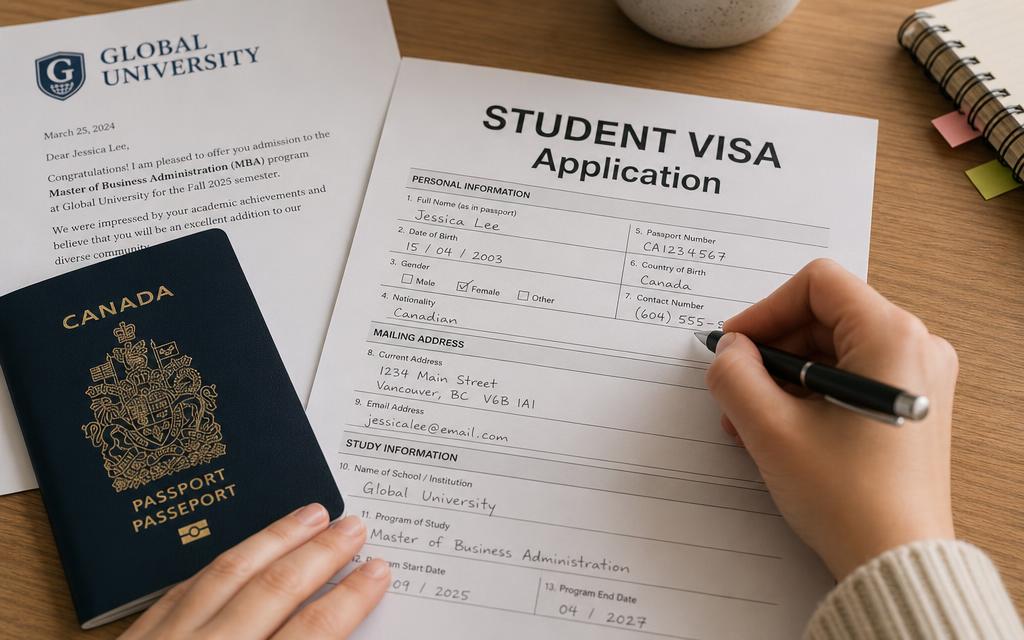
Apply to a designated learning institution, obtain the letter of acceptance and, where required, a provincial attestation letter, then prove tuition plus living costs, often through a Guaranteed Investment Certificate under the Student Direct Stream where available.
Study permits allow limited off-campus work, and a Post-Graduation Work Permit of up to three years follows an eligible programme. Canadian work experience then feeds the Canadian Experience Class, which is the most common route from study to permanent residence.
Work permits
Employer-specific permits usually require a positive Labour Market Impact Assessment showing no Canadian was available. LMIA-exempt permits exist under the Global Skills Strategy, intra-company transfers, trade agreements and francophone mobility, which lets employers outside Quebec hire French-speaking workers without an assessment.
Open work permits are available to spouses of many students and skilled workers, and to post-graduation permit holders.
Costs, timelines, arrival and citizenship
Budget the language test, credential assessment, biometrics, permanent-residence application fee and right-of-permanent-residence fee, medical examination, police certificates, translations, and settlement funds proof unless you already work in Canada.
Express Entry applications are often processed within six months of an invitation; provincial and Quebec routes take longer. After landing you apply for a Social Insurance Number, provincial health coverage and a permanent-resident card, and citizenship becomes possible after three years of physical presence within five years.
If you are applying from Morocco, North Africa, Africa or the Middle East
- French test results (TEF or TCF Canada) are the highest-value investment for Moroccan, Algerian, Tunisian and West African candidates because of the French-language category draws and the francophone mobility work permit.
- Biometrics are collected at designated visa application centres in Casablanca, Rabat, Algiers, Tunis, Cairo, Dakar and other regional cities.
- Proof of settlement funds must be liquid and traceable; consultants who offer to lend or park funds put your whole application at risk.
- Only Regulated Canadian Immigration Consultants and lawyers may charge for advice; verify anyone you pay on the public register before signing.
Frequently asked questions
- Can I immigrate to Canada without a job offer?
- Yes. Express Entry and most provincial programmes do not require one; a job offer only adds points and can speed things up.
- Does French really help?
- Substantially. French-language category draws have much lower score cut-offs, and francophone mobility exempts employers outside Quebec from the labour-market assessment.
- How long does Express Entry take?
- Preparation (tests, credential assessment) takes two to four months, then you wait for a draw, and processing is commonly around six months after an invitation.
- How much money do I need to show?
- Settlement funds are published per family size and updated yearly; they must be available and unencumbered, unless you are exempt because you already work legally in Canada.
- Can studying lead to permanent residence?
- Yes, and it is the most common route: a Canadian diploma, then a post-graduation work permit, then Canadian work experience that scores well in Express Entry.
Not sure which route fits you?
Answer a few questions and we will point you to the work, study or immigration guides that match your situation.