Choosing a country and a programme
Compare four things before anything else: tuition, the language of instruction, whether the diploma is recognised in your field, and the post-study work rights. A cheap programme with no post-study permit is often a worse investment than a costlier one that lets you stay and work.
Public universities in Germany, Norway and much of France charge little or no tuition; Canada, the UK, Australia and the USA charge substantially more but have large scholarship systems and generous post-study permits.
Check that the institution appears on the destination's official list of recognised or licensed providers. A student visa is normally impossible with an unlisted school.
Admission: portals and deadlines
Apply directly to universities or through national portals: Campus France for France, UCAS for UK undergraduate study, Uni-Assist for many German universities, national platforms in Italy (Universitaly) and Spain, and provincial or institutional portals in Canada.
Deadlines run six to twelve months before the intake, and consular capacity is the reason: an offer in July for a September start rarely leaves time for a visa.
Apply to several institutions across two tiers — one ambitious, one realistic — because the visa depends on holding an unconditional acceptance.
Admission documents
Expect transcripts for the last two to four years, a recognised secondary or bachelor's diploma, a language certificate (IELTS, TOEFL, Duolingo where accepted, DELF/TCF for French, TestDaF/DSH or Goethe for German), a motivation letter, a CV and one or two academic references.
Diplomas and transcripts in Arabic or French usually need a sworn translation, and often an apostille or consular legalisation. Some countries also require a pre-assessment of your diploma's equivalence before admission.
Write the motivation letter for the specific programme: named courses, named research, and a coherent link to your previous studies and intended career. Generic letters are the most common cause of rejection at competitive institutions.
Paying for it: tuition, scholarships and sponsors
Build a full budget: tuition, registration fees, rent and deposit, food, transport, insurance, books, and the visa and travel costs. Living costs, not tuition, are the main line in Europe.
Scholarship sources include the destination government (Erasmus+, DAAD, Chevening, Campus France, Canadian institutional awards), your own government or ministry, the university itself, and sector foundations. Most close six to nine months before the intake.
If a family member funds you, their role must be documented: a sponsorship declaration, proof of relationship, and their own bank statements and income evidence.
The student visa application
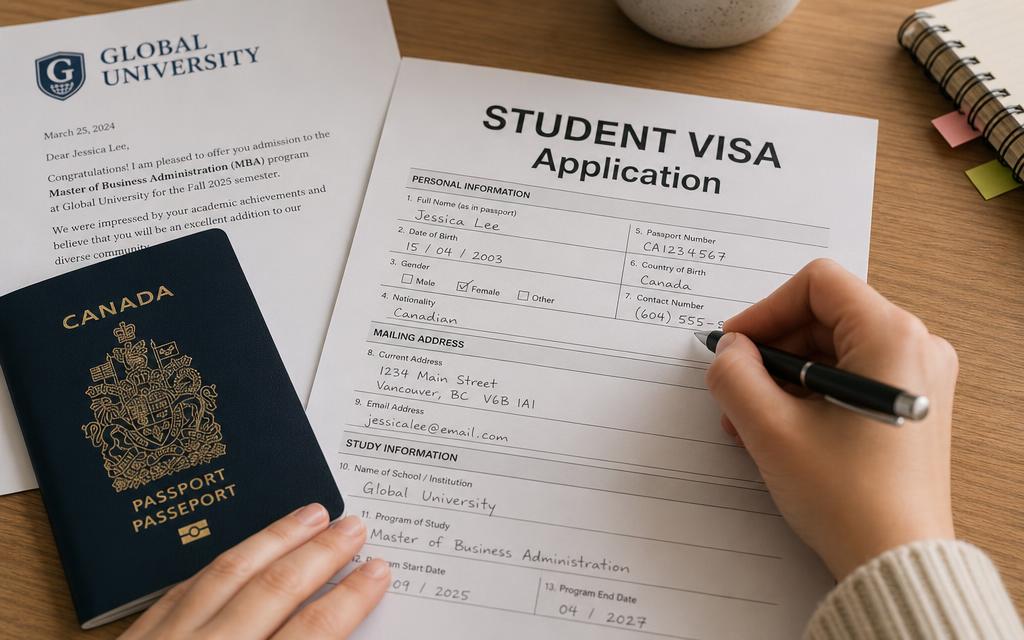
The acceptance letter unlocks the visa file. You will normally need the admission letter, proof of tuition payment or exemption, proof of living funds, accommodation, health insurance, a valid passport, biometrics, and sometimes a pre-departure interview or academic-intent assessment (Campus France, and equivalent interviews for some UK and US applications).
Book the consular or visa-centre appointment as soon as you have the acceptance letter. In peak season the appointment queue, not the decision, decides whether you arrive on time.
Be consistent: the name, course, dates and institution on every document must match the admission letter exactly.
Proof of funds, explained properly
Countries ask for it in different formats: a blocked account with a fixed annual amount in Germany, a defined monthly amount held for a set number of months in the UK and Canada, a bank attestation or sponsor declaration in France, Spain and Italy.
What consulates look for is not a large balance on one day but a plausible, documented history. A sudden deposit shortly before the application is the single most frequent refusal reason for applicants from the region.
Use accounts in your own name or a direct sponsor's name, provide six months of statements, and be able to explain the origin of every significant transfer.
Insurance, accommodation and registration on arrival
Health insurance is compulsory almost everywhere, either through the national student scheme or a private policy that meets a stated minimum cover. Arrange it before travel, since the visa often requires proof.
Accommodation evidence can be a university residence offer, a private lease or a host declaration. University housing is cheaper but usually allocated first-come, so apply the day the portal opens.
After arrival, register your address, enrol formally, obtain your residence card or permit, and open a local bank account. Many countries set a deadline of a few days to a few weeks; missing it can void the permit.
Working during your studies
Most student permits allow part-time work — commonly 20 hours a week during term and full time in holidays, with variants such as Germany's annual working-day allowance.
Part-time earnings help but rarely cover full living costs, and consulates will not accept planned work as proof of funds. Treat it as a supplement, not a plan.
Internships and placements often need a separate authorisation or an agreement signed by the university; do not start unpaid or paid work outside your permit's conditions.
After graduation: post-study work rights
Post-study permits let you stay and look for work: up to 18 months in Germany, two years in the UK Graduate route, up to three years in Canada depending on programme length, and two to four years in Australia.
Apply before your student permit expires; in most systems the post-study permit cannot be requested once you have fallen out of status.
Use the final year, not the graduation month, to job-hunt: internships, career services, alumni networks and sector fairs convert far more reliably than cold applications after the diploma.
From student to resident
The usual chain is student permit, post-study job-search permit, work permit, then permanent residence. Some countries count part of your study time toward the residence requirement; others count none of it.
Language matters most at this stage: local-language ability decides which employers can hire you and is often required for permanent residence.
Keep every enrolment certificate, transcript, payslip and permit. The permanent-residence file asks you to reconstruct the entire period.
If you are applying from Morocco, North Africa, Africa or the Middle East
- Moroccan, Algerian and Tunisian baccalauréat holders have well-established recognition routes into France, Belgium, Spain, Italy and Canada, usually through Campus France or the equivalent office in their country.
- Public universities in Germany, Norway and much of France charge low or no tuition — living costs, not tuition, are the main budget line.
- Proof of funds is the most common refusal point in the region; use accounts in your own or a direct sponsor's name with a clear, documented six-month history.
- Quebec, Belgium, France and Switzerland are attractive for French-speaking students, while Germany, the Netherlands and the Nordics offer many English-taught master's programmes with low fees.
- Beware agencies charging large fees for admission itself. University applications are made directly or through free national portals; paid help is optional and never a guarantee of a visa.
- Gulf universities and branch campuses can be a lower-cost first step, but check whether the diploma is recognised in the country where you eventually want to work.
Frequently asked questions
- Do I need to speak the local language?
- Not always — many programmes are taught in English or French. But local-language ability strongly improves part-time work, internships and post-study employment, and is often required later for residence.
- Can I bring my spouse?
- Usually at master's or doctoral level, subject to proof of extra funds and accommodation. Undergraduate students are generally excluded from bringing dependants.
- How much money do I have to show?
- It depends on the country: a fixed annual amount in a blocked account in Germany, a set monthly figure held for several months in the UK and Canada, and a consulate-defined minimum in France, Spain and Italy. Always check the current figure on the official page.
- Can I work while studying?
- In most destinations yes, typically up to 20 hours a week during term and full time in holidays, provided your permit states it.
- Are scholarships realistic for applicants from Africa and the Middle East?
- Yes — Erasmus+, DAAD, Chevening, Campus France and many university awards are designed for exactly these regions. Apply six to nine months ahead and to several schemes at once.
- Can I switch to a work visa after graduating?
- That is the intended path in most systems: a post-study job-search permit first, then an employer-sponsored or points-based work permit once you have an offer.
Not sure which route fits you?
Answer a few questions and we will point you to the work, study or immigration guides that match your situation.