The skills assessment and skilled lists
Your occupation must appear on a relevant skilled occupation list, and the assessing authority for that occupation must confirm your qualifications and experience are equivalent to Australian standards. Engineers Australia, ACS for IT, TRA for trades and AHPRA for health professions are the common ones.
The assessment is a separate application with its own fee and timeline, usually one to four months. Nothing else can be lodged before it is positive.
The points test
Points come from age, English level, skilled work experience inside and outside Australia, qualifications, partner skills, Australian study and community-language credentials. Sixty-five points is the minimum, but real invitation cut-offs are usually higher.
English is the biggest single lever: proficient and superior scores on IELTS, PTE or equivalent add ten or twenty points, often deciding whether an invitation ever arrives.
The three main skilled visas
Subclass 189 Skilled Independent is permanent and needs no sponsor. Subclass 190 is permanent with nomination by a state or territory, which adds five points and requires a commitment to live there. Subclass 491 is a five-year regional provisional visa that adds fifteen points and leads to permanent residence through subclass 191.
You submit an expression of interest in SkillSelect, then wait to be invited. An expression of interest is not an application and carries no guarantee.
Employer-sponsored routes
The Skills in Demand visa (formerly subclass 482) lets an approved sponsor employ you for up to four years, with a pathway to permanent residence through the employer nomination scheme after a qualifying period.
Regional employer sponsorship (subclass 494) and the Designated Area Migration Agreements open occupations that would not otherwise qualify, in exchange for living outside the major cities.
Studying in Australia
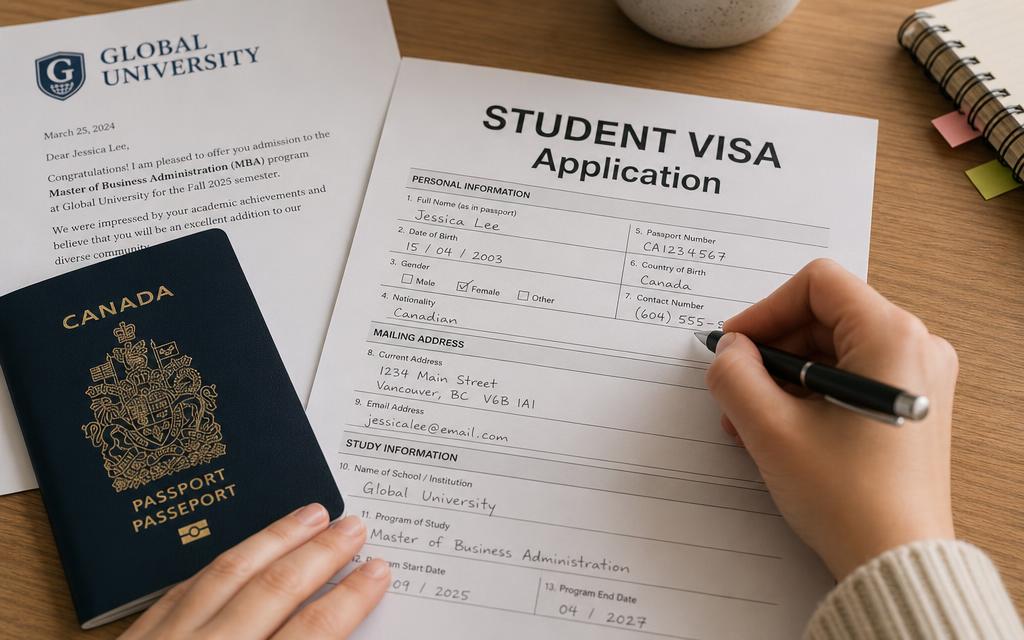
The Student visa (subclass 500) needs a confirmation of enrolment from a registered provider, evidence of funds, health insurance through Overseas Student Health Cover and a genuine student assessment of your intentions and history.
Students may work limited hours during term, and the Temporary Graduate visa (subclass 485) gives two or more years of full work rights after graduation, plus points for Australian study if you later apply for a skilled visa.
Documents, health and character
Prepare passport, skills assessment outcome, English test results, employment references written to Australian evidence standards (role, dates, hours, duties, signed by the employer), qualifications with certified translations, and police clearances for every country lived in for twelve months or more in the last ten years.
Every applicant undergoes a health examination with a panel physician, and everyone over sixteen must satisfy the character requirement. Undeclared history is treated far more seriously than the history itself.
Costs, timelines and permanent residence
Budget the skills assessment, English test, visa charge (which is substantial and rises for each family member), medicals, police certificates and translations. Skilled visas commonly cost several thousand Australian dollars per family.
Typical end-to-end time from skills assessment to visa grant is nine to eighteen months. Once granted, subclasses 189 and 190 are permanent immediately; citizenship follows after four years of lawful residence including one year as a permanent resident.
If you are applying from Morocco, North Africa, Africa or the Middle East
- There is no Australian visa office in most of North Africa; applications are online and health examinations are done with panel physicians in Casablanca, Cairo, Tunis, Algiers or a nearby designated clinic.
- Work reference letters from Morocco and the wider region are often too brief for Australian standards. Ask employers to state exact dates, weekly hours and detailed duties, then have them translated by a certified translator.
- Community-language points are available for accredited translators and interpreters, which can help Arabic and French speakers reach the invitation cut-off.
- Beware agents promising nomination or invitation; only registered migration agents may advise for a fee, and their register is public.
Frequently asked questions
- Do I need a job offer to move to Australia?
- No. Subclasses 189, 190 and 491 are points-tested and need no employer, though sponsorship is an alternative route if your points are low.
- How many points do I really need?
- Sixty-five is the floor, but competitive occupations often need eighty or more, so maximise English, experience and state nomination.
- How long does a skills assessment take?
- Usually one to four months depending on the assessing authority and how complete your evidence is.
- Can my family come with me?
- Yes. Partners and dependent children are included in the same application, with work and study rights, and each adds to the visa charge.
- Is regional Australia easier?
- Generally yes. Regional visas add points, have wider occupation lists and lower cut-offs, in exchange for a residence commitment outside the biggest cities.
Not sure which route fits you?
Answer a few questions and we will point you to the work, study or immigration guides that match your situation.